
Case Study — Kingdomes, Australia
The launch, and the clicks that were lying
How do you sell something nobody's heard of? I built the launch for Australia's first frameless dome, then caught a stream of fake traffic quietly eating the budget.
“You can't fish where the fish already are. You have to make the fish.”
Nobody searches for a thing they don't know exists
The Aura Dome is Australia's first frameless polycarbonate geodesic dome. No steel skeleton inside. The see-through panels are the structure, made from the same material as fighter jet canopies, with a mirrored outside that reflects the landscape. From $12,000, fifty units for the year.
Marketing problem: when you're first of your kind, there's no demand waiting to be caught. Nobody types "frameless polycarbonate dome" into Google because nobody knows it's a thing.
You can't fish where the fish already are. You have to make the fish.
Two campaigns, in the right order
A first-of-its-kind product doesn't get one campaign. It gets a sequence, and the order matters more than the ads.
Step one: introduce, don't propose. Running "enquire now" at people who've never heard of you is asking strangers to marry you. The first campaign had a humbler job. Put the dome in front of the right people and let them look. Everyone who stopped, watched or clicked became a data point, and a list.
Step two: now propose. Once that warm pool existed, people who'd visited the site, watched the videos, lingered, the second campaign spoke only to them with sales-forward ads. Different message, because they'd already met the product.
This is the $100M Leads idea about engaged leads doing the work. A stranger who's seen nothing is worth almost nothing to sell to. The first campaign's actual product isn't clicks, it's a pool of people who've met you. You pay for the introduction once, then sell into it repeatedly.
Around the ads: the launch page, email follow-ups, a stream of organic video (the dome sells itself on camera, my job was giving it enough cameras), YouTube optimisation, and a Facebook community play.
The part where the numbers lied
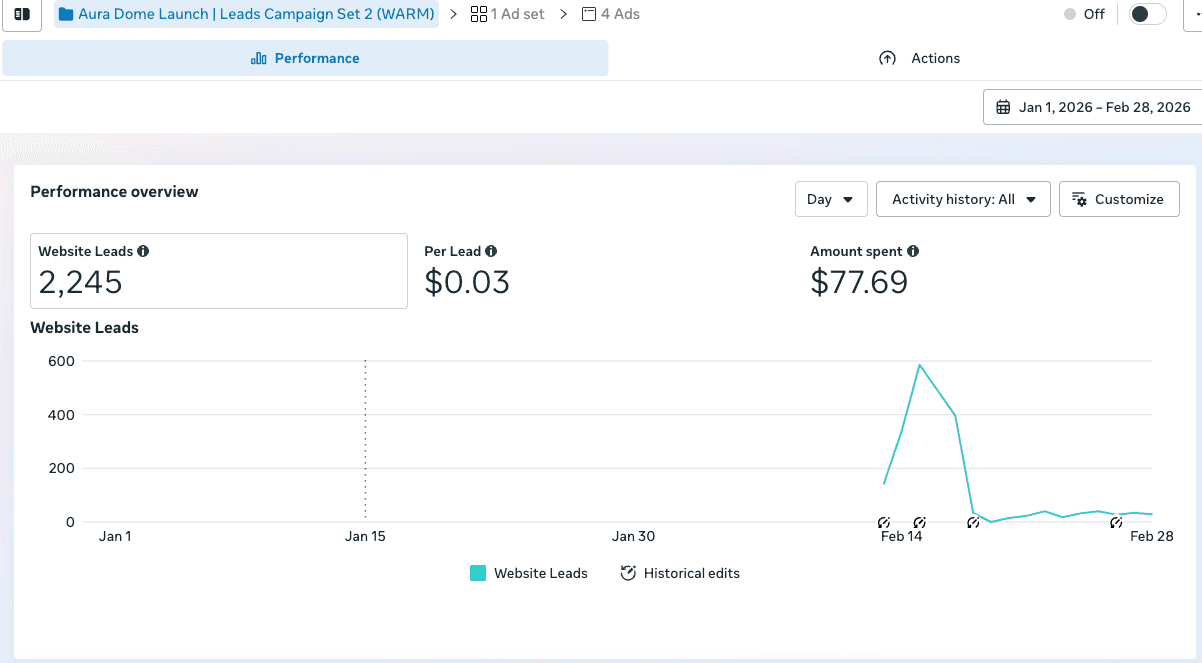
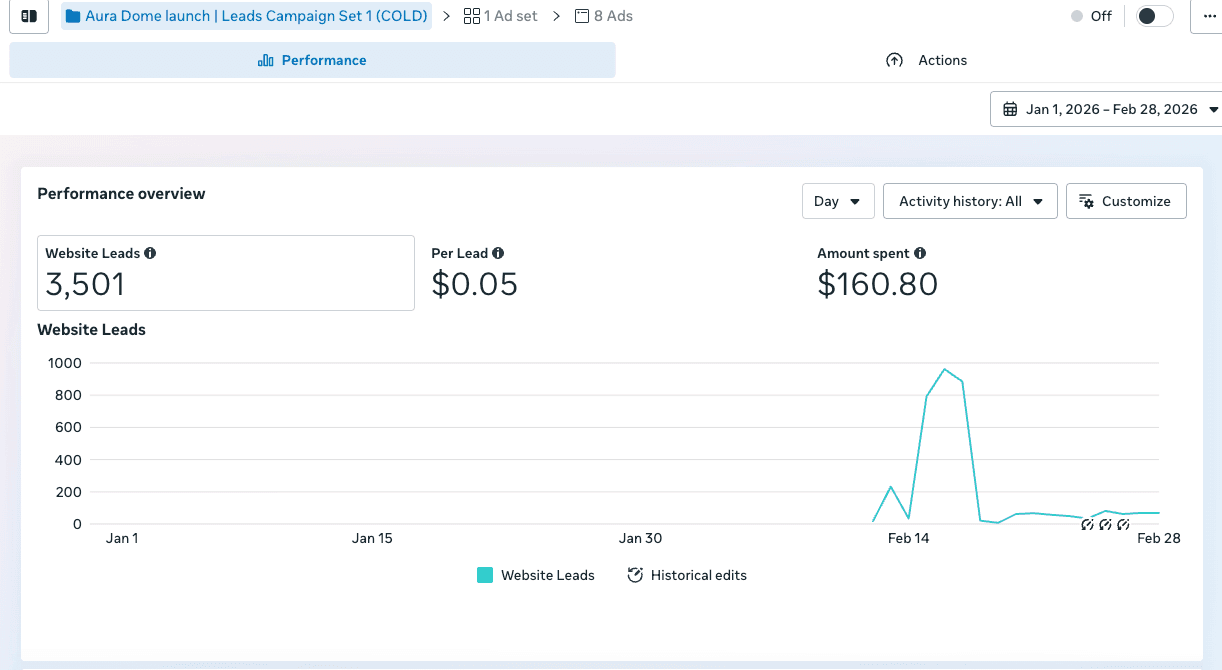
Early results looked great. Loads of clicks, dirt cheap. Which is exactly why I didn't trust them.
Good numbers that arrive too easily deserve an interrogation.
So I dug into where the clicks came from. A big chunk was coming from rewarded ads inside mobile games, the placements where people tap an ad to earn coins for a puzzle game. Those weren't future dome owners. They weren't even really looking. Accidental thumbs, inflating every number on the dashboard while being worth nothing.
Left alone, that leak does two kinds of damage. It burns money directly, because you're paying for those taps. The sneakier damage is that Facebook's system learns from clicks. Feed it fake ones and it decides your ideal customer is someone grinding a match-three game at 2am, then goes and finds you thousands more of them. The campaign gets worse while the dashboard insists it's improving.
Fix: cut the placements, clean the audience data, rebuild reporting around numbers an accidental tap can't fake. Time on page, scroll depth, enquiry quality.
The dashboard got uglier. The traffic got real.
What got built
- The full campaign structure: introduce phase, propose phase, audiences, exclusions, creative direction for video and stills
- The launch page
- Email follow-ups for enquiries and long-term nurture
- A 10-video organic launch series scripted for the founder, each with its own comment trigger word feeding an automation that replies and captures leads on its own
- YouTube optimisation and the Facebook community strategy
- The audit habit that came out of it, now a house rule: the prettier the dashboard, the harder it gets checked
Where it stands
The Aura Dome launched with ads learning from real humans, a page built to convert them, and a content engine around a founder on camera and a product that photographs like a render.
Cheap traffic is the most expensive kind.
“You can't fish where the fish already are. You have to make the fish.
“Good numbers that arrive too easily deserve an interrogation.
“The dashboard got uglier. The traffic got real.
“Cheap traffic is the most expensive kind.
This project ran on
More stories like this one, or something specific on your mind?