
Case Study — Kingdomes / Glamporise, Australia
The customer who fired my best idea
A client handed me a solid product with no way to sell it. Then one stranger at an expo said something that made me throw out half my work.
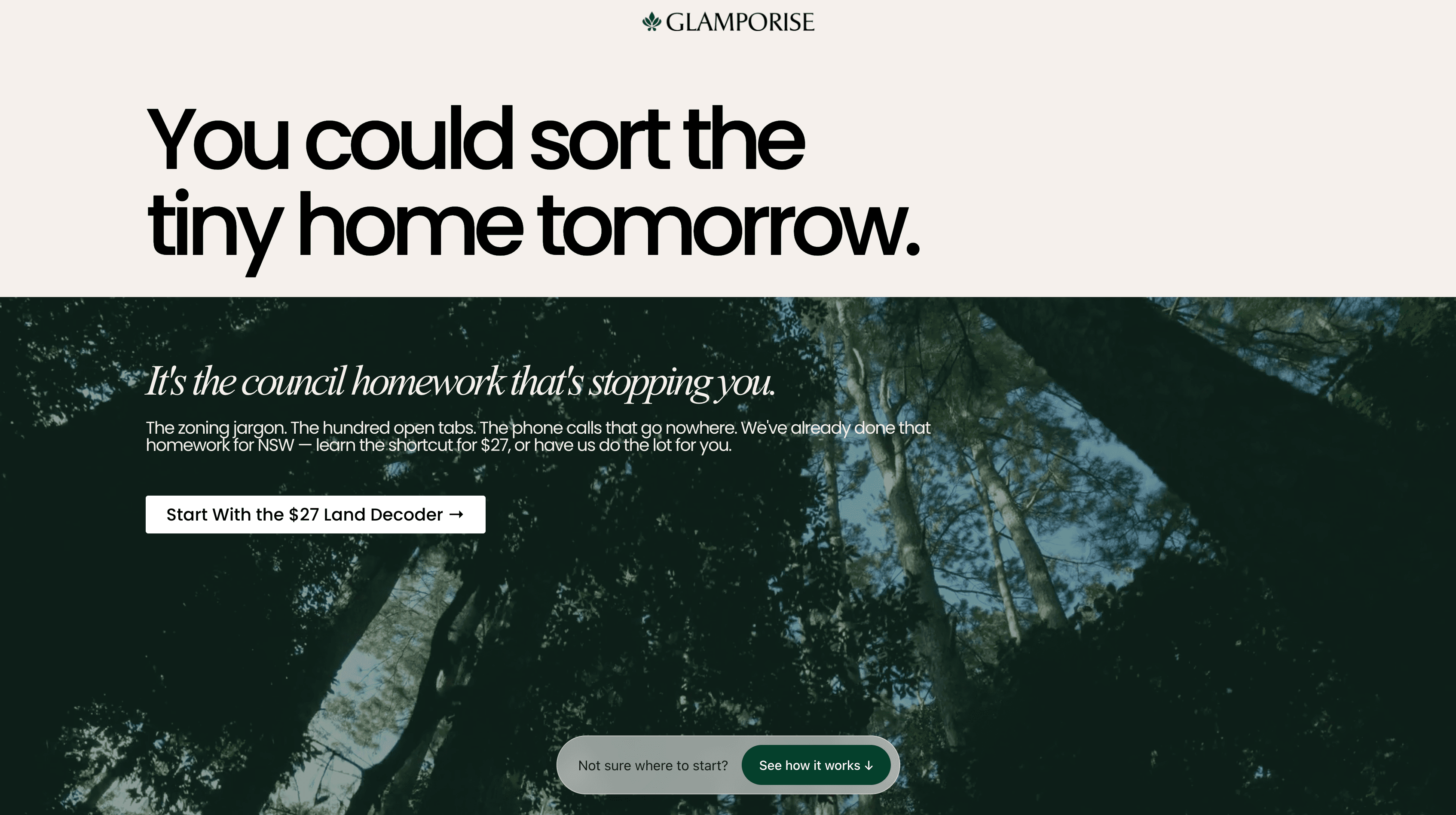
The pile of gold nobody could buy
Jesse runs Kingdomes, an Australian company that builds geodesic domes. I run his marketing systems. One day he sent me 18 files for a new idea: helping people in New South Wales work out whether their land can legally hold a tiny home.
Worth knowing, if you're not Australian: you can own a beautiful block of land and still not be allowed to put a tiny home on it. The council decides. Finding out what your council allows means weeks of government websites, zoning documents, and forum threads where everyone contradicts everyone.
Jesse's files had real answers to all of it. The kind people pay for.
But expertise in a folder isn't a product. No offer, no pricing that made sense, no reason for a stranger to hand over a card. A pile of gold with no shop around it. My job was the shop.
The enemy I picked
Whenever I build an offer I start with one question: what is the customer actually fighting? Everything else gets built on that answer.
My first one: buying land in the wrong order. People buy the block, then find out the council won't let them build. Money lost, dreams crushed. Very dramatic. I built the whole strategy around it.
Then Jesse worked a booth at an expo, and a bloke walking past said this:
“I'm good with building the tiny home. It's scouring the internet and all the council stuff that's not for me.”
He wasn't scared of buying wrong. He was sick of the homework. The tabs, the PDFs, the not knowing who to believe. Not a catastrophe. A chore.
So: defend the strategy I'd already built, or take the better one a stranger just handed me.
Scrapping a finished strategy on one overheard sentence isn't a great look, if I'm honest. But the alternative is worse: knowing the framing is wrong and shipping it anyway because you'd already done the work. Sunk cost is a terrible reason to sell somebody the wrong thing.
Skip the council homework.
Why three products and not one
Hormozi's $100M Offers has a formula I use on everything: dream outcome, times how likely they believe it'll work, divided by how long it takes and how much of a pain it is. Push the top up, drag the bottom down.
The council maze is almost entirely bottom-half. Time and hassle. So the product wasn't information. Jesse's files already had that. The product was removing the homework.
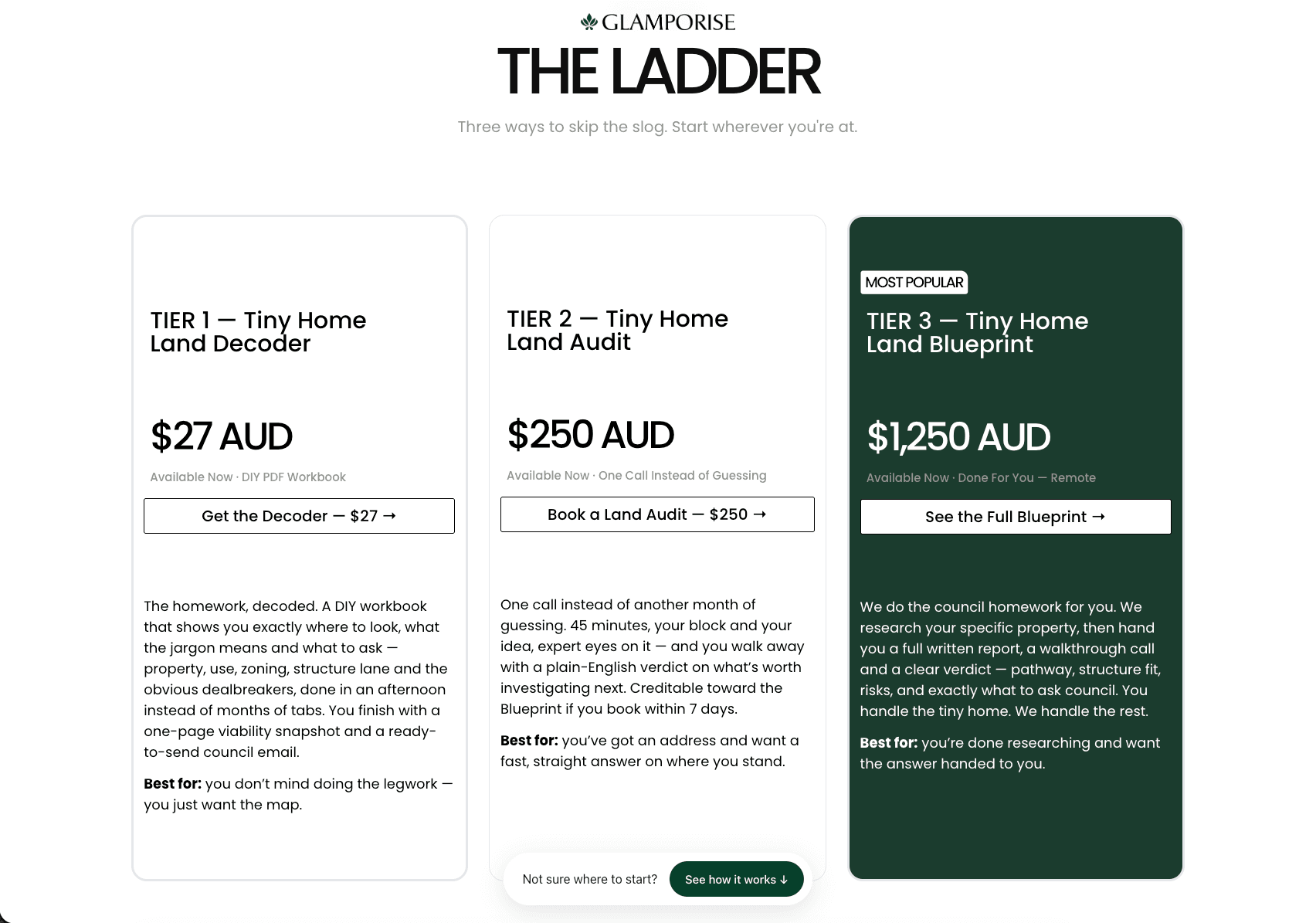
Then $100M Money Models answers the next question: how many ways can someone buy this? Different people show up at different stages of ready. One price serves one of them and turns the rest away.
The Land Decoder — $27. Weeks of research turned into a step-by-step process. Priced so buying it isn't a decision. Its job isn't the $27. It's the trust, and the buyer list.
The Land Audit — $250. We look at your actual block, get on a call, tell you straight what you're dealing with.
The Land Blueprint — from $1,250. We do the homework. You skip it entirely.
All three named around one word, land, so they read as a family instead of three random things. A $27 buyer isn't a cheap customer. They're a $1,250 customer who hasn't finished climbing yet.
The guarantee, and why it's a weird one
Risk reversal is the last piece of the Hormozi stack, and the obvious move here was a results guarantee. We didn't. Nobody can promise a council says yes, and a promise you can't keep is just a refund with extra steps.
So: we don't guarantee approval. We guarantee you'll know exactly where you stand.
In a market full of consultants being vague, saying plainly what you can't do makes everything else believable.
Then I built the machine
- The Land Decoder guide, written cover to cover
- A sales page for each product, plus the main page tying them together
- Video sales scripts for all three
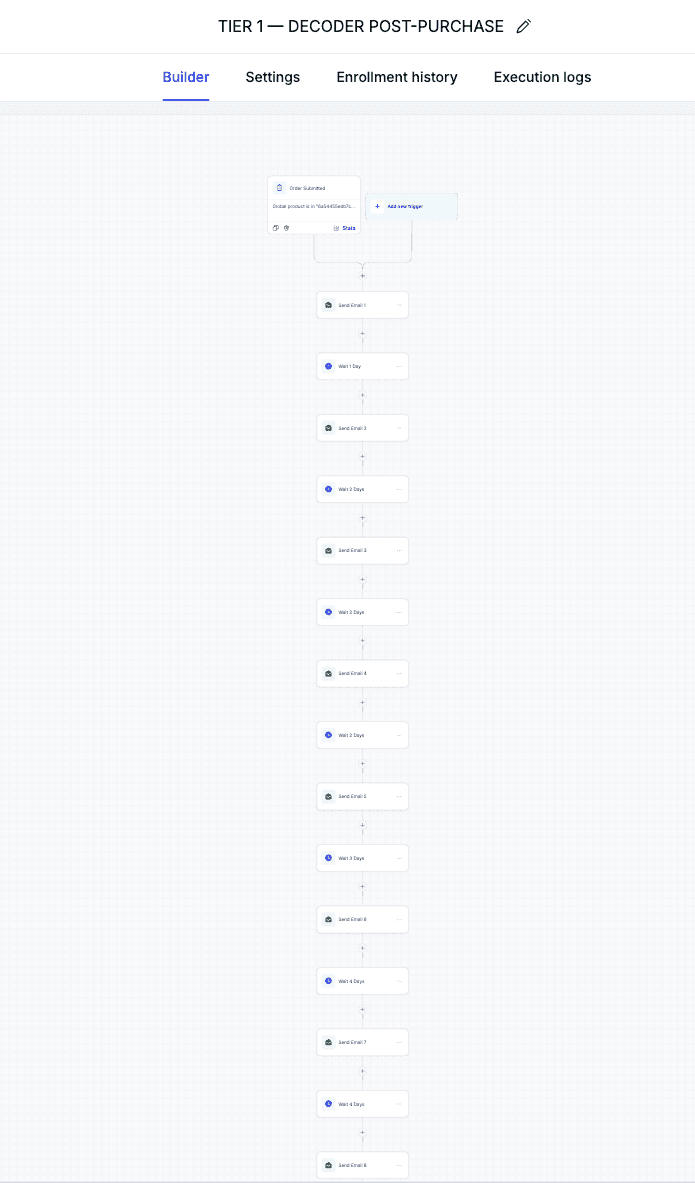
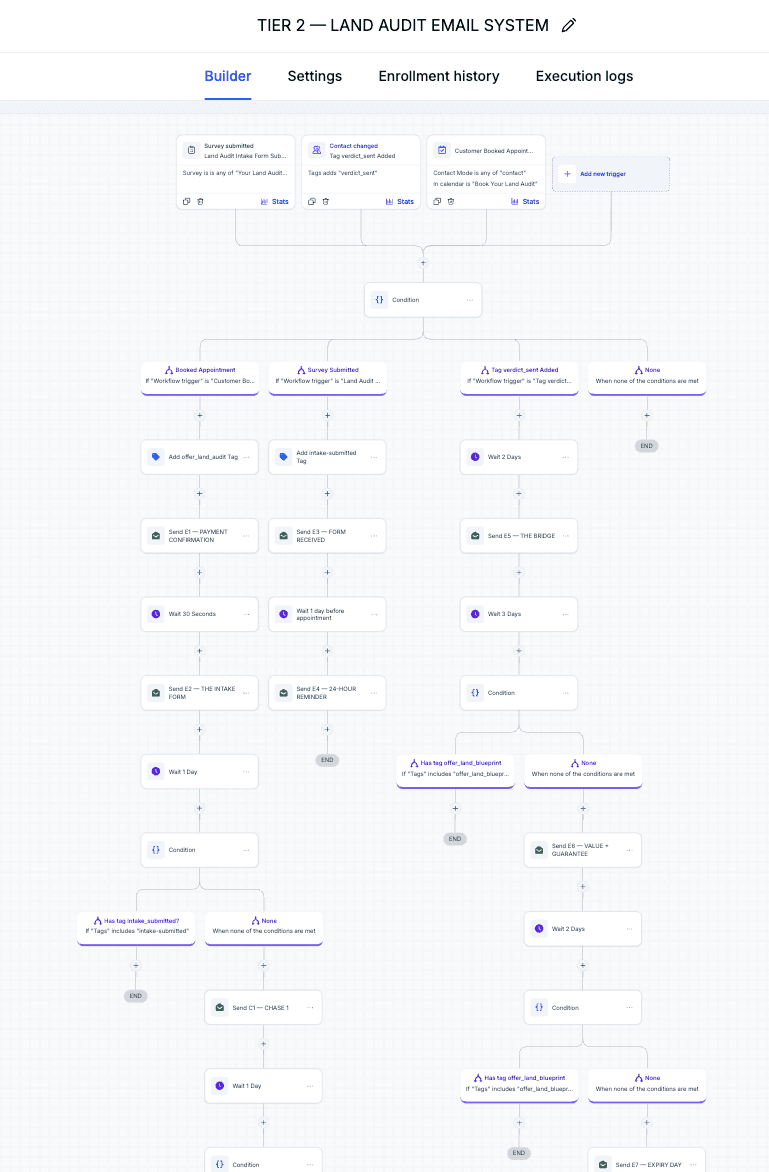
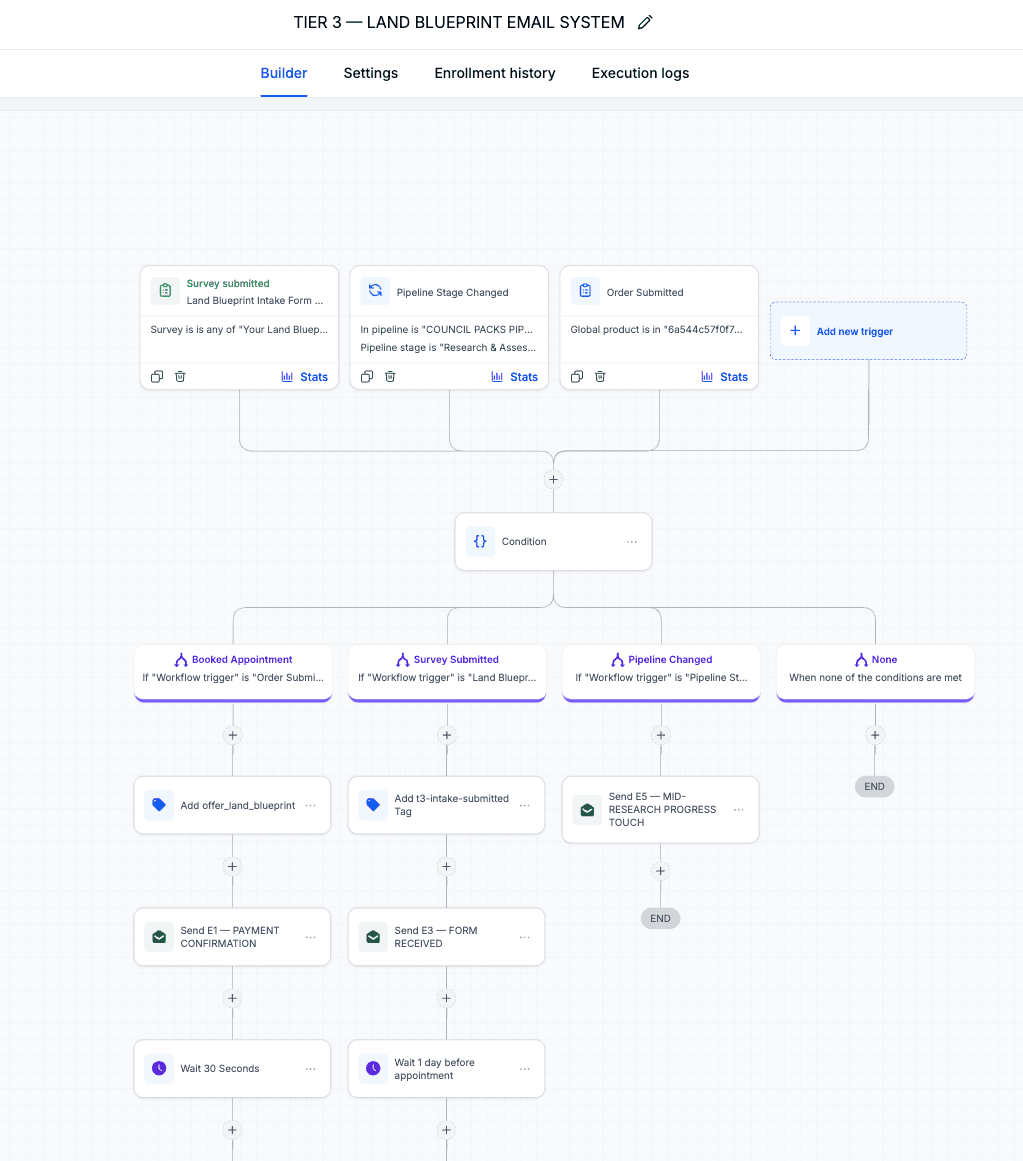
- 35 emails. The follow-up that welcomes buyers, handles doubts, and walks someone from the $27 guide toward the bigger products over weeks, without anyone touching a keyboard
- Forms, tags, and the workflows that run it
Where it stands
Built and staged. The client's launch calendar decides when it switches on.
I threw out a good strategy because one bloke at a booth had a better one. That's the whole story.
“Expertise in a folder isn't a product.
“He wasn't scared of buying wrong. He was sick of the homework.
“Sunk cost is a terrible reason to sell somebody the wrong thing.
“A $27 buyer isn't a cheap customer. They're a $1,250 customer who hasn't finished climbing yet.
This project ran on
More stories like this one, or something specific on your mind?