
Skill
Paid Ads
Campaigns built in the right order — and audited hardest when the numbers look pretty.
Ads aren't magic; they're an amplifier. Point them at the wrong message, the wrong audience, or the wrong objective, and they amplify waste with impressive efficiency. I build ad campaigns as sequences — introduce before you propose — and I treat every suspiciously good dashboard as a suspect until proven innocent.
How I approach it
Introduce before you propose. Cold audiences get awareness-building, not "buy now" — asking strangers to commit on first sight is how budgets die. The warm pool gets built first; the selling comes second, to people who've already met the product.
Engaged leads, not just leads. From Hormozi's $100M Leads: a lead who hasn't shown real interest isn't a lead, it's a name. I build ad systems that measure engagement — who watched, who lingered, who came back — because that's the pool worth spending money to grow. Paid ads are one of the Core Four ways to get customers; I run them as part of that bigger machine, never as the whole plan.
Feed the algorithm the right lessons. Ad platforms learn from every click. Feed them junk clicks and they'll hunt down more junk for you, efficiently. I guard what the system learns as carefully as what it spends.
Interrogate pretty numbers. Cheap clicks arriving too easily is a symptom, not a victory. I dig into where results come from — and I've found fake traffic hiding inside beautiful metrics more than once.
Measure what can't be faked. Time on page, scroll depth, enquiry quality — numbers an accidental tap can't inflate. Uglier dashboards, realer results.
The bookshelf behind this
$100M Leads (Hormozi) for the lead machine ads belong to · Influence (Cialdini) for why certain hooks stop thumbs · and hard-earned scar tissue for everything the dashboards won't tell you.
Where I've done it
Launching a product nobody was searching for. Full-funnel launch for a first-of-its-kind five-figure product: awareness phase feeding the pixel, retargeting phase closing, creative direction throughout — and the placement audit that caught a stream of fake game-reward clicks quietly eating the budget and poisoning the algorithm. Cut the leak, cleaned the data, rebuilt the reporting.
Full story →Ads as one gear in a bigger machine. The campaigns I run never stand alone — they feed email systems, qualification engines, and follow-up paths built to catch what the ads bring in.
Full story →The actual work
Warm campaign, 2,245 leads at $0.03 each. Every number on this screen is a problem.
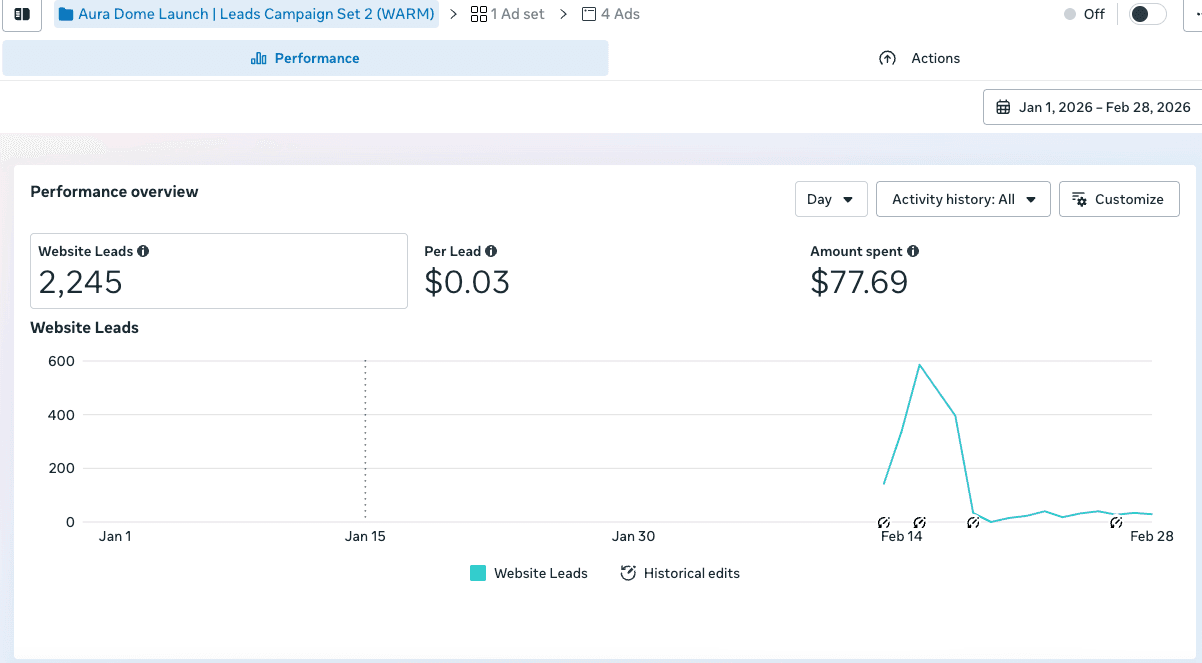
What's wrong with this picture
The tell
$0.03 per lead on a product that starts at $12,000. Meta's own benchmark for comparable campaigns sits around $17 per lead. When your cost per lead is five hundred times better than the industry, you haven't found an edge. You've found a bug.
Where they came from
Audience Network rewarded video. Ads shown inside mobile games, where a player watches your video to earn coins for their puzzle game. They sat through the whole thing, which is why the metrics looked so healthy. They were waiting for it to end.
Why it's worse than wasted money
$77 isn't much to lose. The real damage is what the pixel learned. Meta optimises toward whoever engages, so every fake lead taught it that the ideal Aura Dome customer is a mobile gamer farming rewards. Left running, the campaign would have got steadily worse while the dashboard looked better every week.
The fix
Manual placements only. Facebook and Instagram feeds, stories, reels. Audience Network off, Messenger off. Cost per lead went from $0.03 to around $1.39 on Facebook feed, and those were people who actually looked.
What replaced the metric
We stopped reporting cost per lead as the headline number. Real leads on feed placements cost more and are worth more, so the campaign now gets judged on lead quality and enquiry follow-through instead of a number an accidental tap can inflate.