Skill
Email Systems & Automation
The salesperson that never sleeps, never forgets, and never gets tired of following up.
Most sales don't happen on the first visit — they happen in the follow-up nobody has time to do manually. I build email systems that do it automatically: welcoming buyers, answering doubts, nudging the almost-ready, and staying patiently useful to the not-yet — for weeks or months, without anyone touching a keyboard. And I make sure they actually land in inboxes, which is half the battle nobody talks about.
How I approach it
Sequences are conversations, not blasts. Each email answers the question the reader's actually asking at that moment — day one's doubt is different from day fourteen's. I map the psychology first, then write to it.
Carnegie before copywriting. My email voice runs on How to Win Friends and Influence People: genuine appreciation before any ask, the reader's point of view before mine, and never making anyone feel wrong — even in a rejection email. I've literally written client emails with Carnegie's principles as the checklist, and they're the ones that get warm replies.
Small yeses before big ones. From Cialdini's Influence: people stay consistent with commitments they've already made. So sequences ask for tiny steps first — a download, a reply, a quiz — and each small yes makes the bigger one natural. Give value before asking for anything (reciprocity isn't a tactic; it's just how trust works).
Different people, different paths. A buyer, a browser, and a gone-quiet lead should never get the same email. I build the tagging and branching so everyone's on the path that fits them — automatically.
Deliverability before creativity. The world's best email is worthless in a spam folder. Domain authentication, sending reputation, technical setup — I fix the plumbing first. I've rescued clients whose beautiful emails simply weren't arriving.
Built to run without me. Every system documented and automated. When I hand it over, it keeps selling.
The bookshelf behind this
How to Win Friends and Influence People (Carnegie) for how the emails talk · Influence (Cialdini) for why people say yes · $100M Leads (Hormozi) for how sequences fit the bigger lead machine.
Where I've done it
35 emails behind one product ladder. Three sequences walking buyers from a $27 guide toward a $1,250+ service — welcome, nurture, and upgrade paths — running on their own for 28 days and beyond.
Full story →The deliverability rescue. A client's emails were quietly dying before reaching inboxes. Domain authentication rebuilt (Mailgun, DMARC alignment) — the machine's messages started landing again.
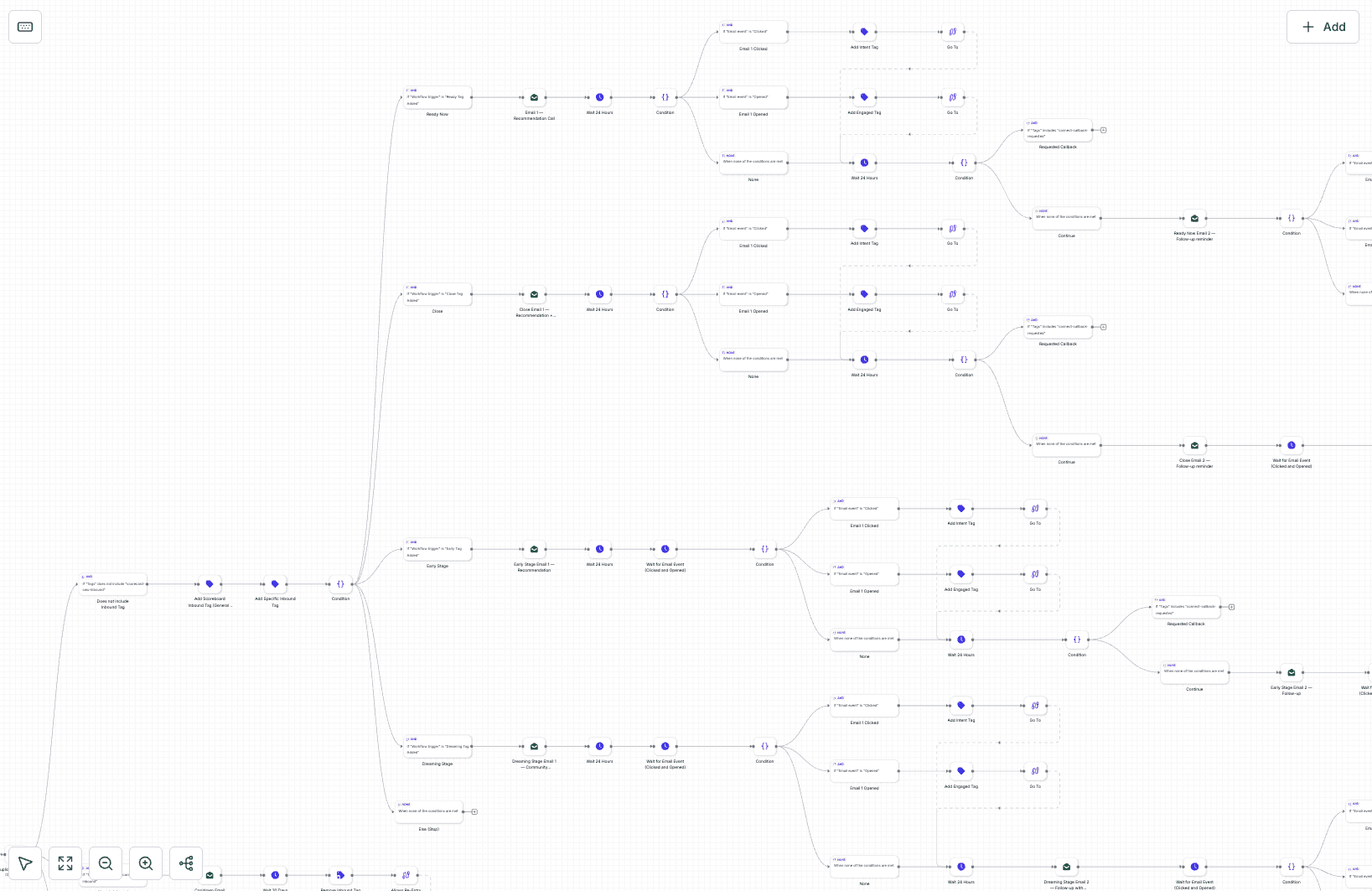
Full story →A three-lane follow-up brain. Ready-now, close, and someday leads each get a completely different email experience — including the courtesy of not being pestered.
Full story →Two campaigns wearing one event. Past leads and cold strangers hearing the same market news needed opposite messages — so they got separate sequences, with tested subject lines.
Full story →The actual work
Ten emails walking a $27 buyer toward a $1,250+ service: the welcome, the doubt-handlers, the case-study emails, the upgrade invitation. Laid out so you can see the arc, not just the count.
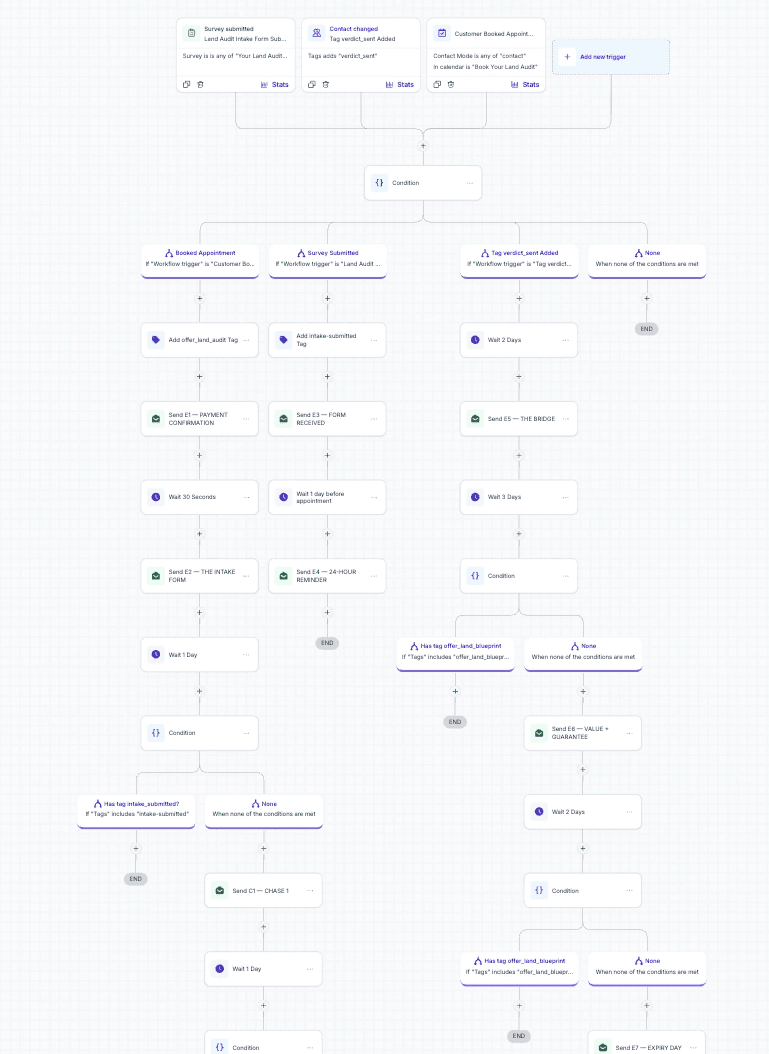
What all those boxes actually do
Four ways in, one path forward
Top of the map has separate triggers: survey submitted, contact updated, appointment booked, verdict sent. Same customer, different doors, depending on how they arrived. Every automation I build starts here, because a system that only works when people behave in the expected order isn't a system.
The emails are numbered for a reason
E1 payment confirmation. E2 the intake form. E3 form received. E4 the 24-hour reminder. E5 the bridge. E6 value and guarantee. E7 expiry day. Numbered and named, so anyone who opens this workflow in a year can tell what it does without asking me. That naming discipline is the difference between a system someone can maintain and a haunted house nobody dares touch.
The waits are the copy
30 seconds after payment. One day before the appointment. Two days here, three days there. Those gaps are decisions, not defaults. A confirmation that arrives instantly feels like a receipt; one that arrives four days later feels like being forgotten.
The chase branch
Bottom left. If the intake form hasn't been submitted, chase. If it has, skip and continue. Most people who buy a $250 audit don't fill in the form straight away, and without this branch they'd sit in limbo while the business assumed everything was fine.
Every path ends
Look at the END nodes. Every branch terminates somewhere deliberate. Automations that don't end properly are how people get emailed about something they bought last year.
One event, three completely different email experiences depending on how ready the person is — including the courtesy of not pestering the not-yet-ready.