
Skill
Offer Architecture & Funnels
What you sell, how it's priced, and why a stranger says yes.
Most businesses don't have a marketing problem — they have an offer problem wearing a marketing costume. The product is good, but there's no clear reason to buy now, no easy first step for the cautious, no path from small purchase to big one. I design that path: the products, the prices, the order, and the funnel that walks people through it.
How I approach it
Start with the enemy, not the product. Every offer gets built around the thing the customer is actually fighting — and I test that assumption against real customers before betting the build on it. My best-known project exists because one stranger's sentence fired my original idea.
Make saying no feel stupid. I build offers on the Value Equation from Hormozi's $100M Offers: raise the dream outcome and the customer's belief it'll work for them, slash the waiting and the effort. Every product ladder I design is that equation, applied rung by rung — plus guarantees that reverse the risk honestly.
Position where nobody's competing. Before building, I run the Blue Ocean questions — what does this industry take for granted that we can eliminate, and what can we create that nobody offers? My proudest positioning win came from finding a step in the customer journey no competitor owned, and planting the brand there.
One promise, several price doors. Not everyone's ready to spend big on day one. I build ladders — a cheap, no-brainer first step that earns trust, a middle option for the committed, a done-for-you top tier — all telling one story, so climbing feels natural.
Design on paper before building anything. The full path gets mapped — every page, every price, every "what happens next" — before a single word of copy gets written. Cheaper to fix a drawing than a building.
The bookshelf behind this
$100M Offers and $100M Money Models (Hormozi) for offer construction and ladder economics · Blue Ocean Strategy (Kim & Mauborgne) for positioning where competition is irrelevant. I don't skim these — I re-read them, and you'll find their fingerprints on every ladder in my case studies.
Where I've done it
A three-product ladder rebuilt around the real enemy. $27 guide → $250 audit → $1,250+ done-for-you, one spine, one promise, 35 emails behind it. Including the part where a customer's single sentence made me rebuild the whole thing.
Full story →A brand designed as a product-making machine. Four stages from $27 to $1,978, with a credit system so nobody's punished for starting small — and a repeatable recipe for making the next ladder, and the next.
Full story →The actual work
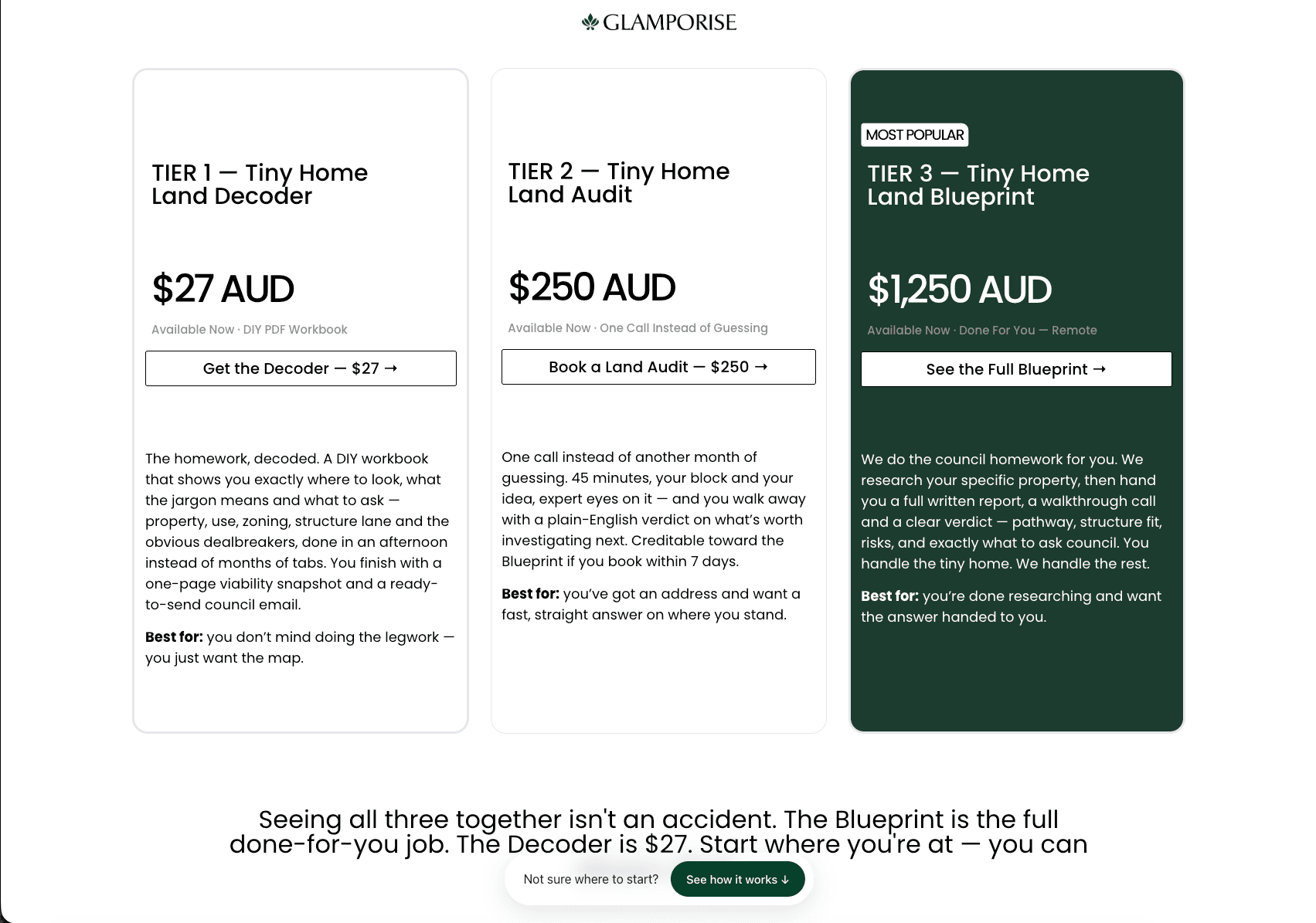
The full architecture: $27 entry guide, $250 audit, $1,250+ done-for-you, all named around one spine word so they read as one family. Includes the pricing logic and the guarantee structure.
Why it's built this way
Why these three prices
The $27 isn't priced to make money. It's priced so buying it isn't a decision. Its job is to turn a stranger into a buyer, because a buyer list behaves nothing like a lead list.
The $250 exists for the people who don't want to do the work but aren't ready to hand over $1,250. Without it, everyone who isn't ready for tier three falls out of the funnel entirely.
The $1,250 is the actual business. Tiers one and two exist to fill it.
Why they're all named “Land”
Decoder, Audit, Blueprint. One spine word, three escalating verbs. Named separately, they'd read as three unrelated products and a customer would have to work out which one they want. Named as a family, the ladder is self-explanatory: you can see where you are and where you'd go next.
Why every tier says “Best for:”
Look at the bottom of each card. Nobody's being sold up. Each tier tells you plainly who it's for, including who it isn't for. The tier three card ends with “you're done researching and want the answer handed to you” — that's disqualifying language on your most expensive product, and it makes the choice feel like the customer's rather than the seller's.
The line under all three
“Seeing all three together isn't an accident.” Saying the strategy out loud, on the page, is a trust move. It also removes the anxiety of wondering whether you're being funnelled.
The guarantee
We don't promise the council says yes. Nobody can. We promise you'll know exactly where you stand. In a market full of vague consultants, saying what you can't do makes the rest believable.
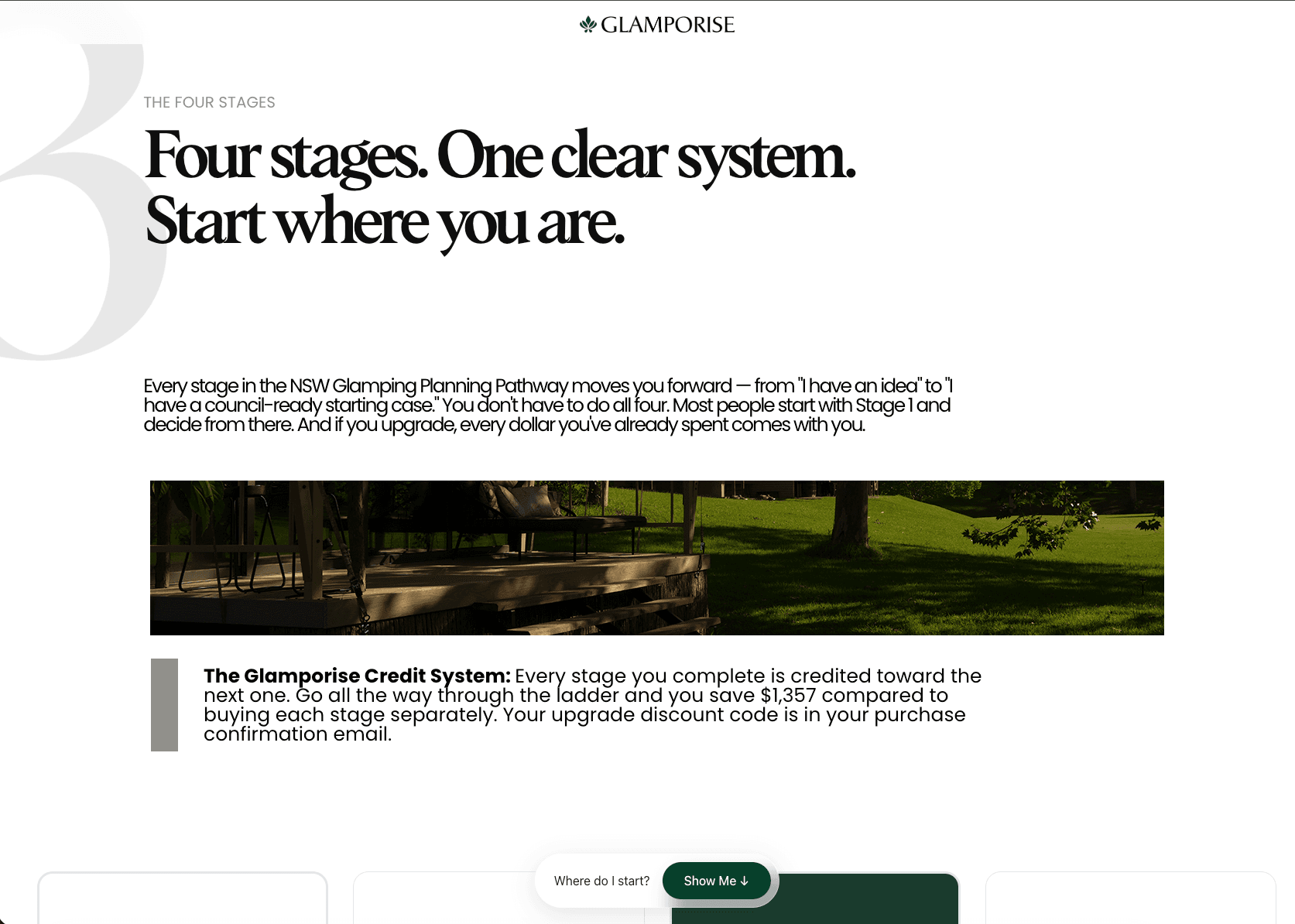
$27 to $1,978, where every stage's payment credits toward the next — so nobody's punished for starting small.
The credit ladder mechanics
Why credit instead of discount
A discount makes the entry product cheaper. Credit makes it free in hindsight. Same money, completely different feeling. Someone weighing the $27 stage isn't calculating a loss anymore, because if they climb, that $27 comes back to them.
What it removes
The real thing blocking a small first purchase isn't the price. It's the fear of wasting it. Buy the starter, then decide you want the full thing, and now you've paid twice for overlapping work. Everyone's been burned by that. Credit kills the objection before anyone has to raise it on a call.
Why the number is stated
$1,357 saved across all four stages. Not “save more when you upgrade.” A specific figure a person can check by adding up the tiers themselves. Vague savings claims get ignored; arithmetic gets trusted.
“Most people start with Stage 1 and decide from there”
That line is doing quiet work. It tells a nervous visitor what normal looks like, which removes the pressure to choose correctly. And it gives permission to start small, which is exactly where we want people entering.
Where the code lives
The upgrade code arrives in the purchase confirmation email, not on the sales page. So the ladder isn't a pricing table anymore, it's a sequence: buy, receive, get invited upward. The email system carries the ladder.
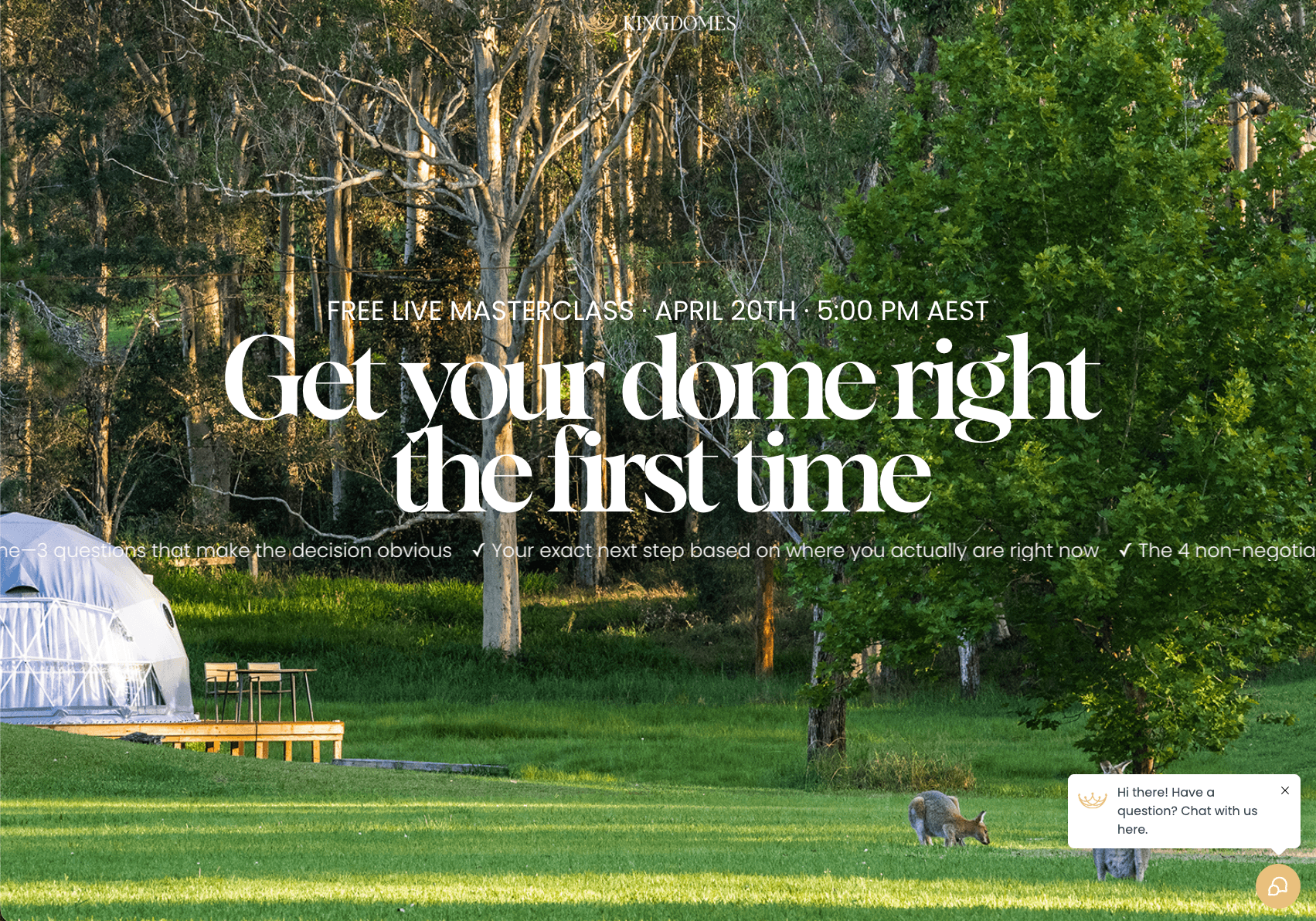
A free masterclass built as the front door to a five-figure product, with a founding offer for the ready-now buyers behind it.
Why the front door is free
Why free, when the product is five figures
Nobody spends $12,000 on a structure after clicking an ad. The gap between “that looks nice” and “I'm ready” is months of quiet worry: will the council allow it, will it survive the weather, is this a mistake I'll be looking at for ten years. A free class is the only offer that fits a decision that slow. It costs the buyer nothing but an hour, and an hour is what it takes to answer the worry.
“Get your dome right the first time”
The headline isn't selling a dome. It's naming the fear of getting it wrong. That's a five-figure buyer's actual thought, and it doesn't require anyone to be sold on domes first. People who haven't decided whether still want to know how not to stuff it up.
The three ticks under the headline
Questions that make the decision obvious. Your exact next step based on where you are. The non-negotiables. Every one of them is about the attendee's situation, not about Kingdomes. The class earns the sale by being useful first, which is the only thing that works when the price tag is high enough to frighten people.
Why a founding offer at the end
The class creates a window where someone is informed, warm, and briefly certain. That certainty fades within days. The founding offer exists to give the ready-now buyers somewhere to go while it's still there. Everyone else gets a lane that isn't a sales call, which is the sorting machine's job.
Live date on the page
A named date and time makes it an event, not a resource. Resources get bookmarked. Events get attended.